How To Compare Removable Outdoor Furniture Covers For Fit
A practical step-by-step guide to how to compare removable outdoor furniture covers for fit, including preparation, instructions, common issues, tips, and next steps.
How To Compare Removable Outdoor Furniture Covers For Fit
Comparing removable outdoor furniture covers for fit is mostly about matching cover dimensions to the furniture’s real shape, accounting for slack, fasteners, and weather exposure. This guide walks you through measuring, test-fitting, and judging coverage so you can pick a cover that stays put and protects well.
Fast Answer
- Measure your furniture at its widest points, then compare those numbers to the cover’s listed dimensions and shape notes.
- Test the cover’s corners, hem, and fasteners with the furniture in place before you decide it fits.
Before You Start
- Gather a flexible tape measure, a notepad, and a helper if the furniture is large or awkward to reach around.
- Clear the furniture of cushions, clips, or decor that could change its footprint or height during measuring.
- Note the furniture’s overall shape, including whether it is rectangular, curved, or has arms and a back that stick out.
- Check the cover’s product page for fit notes, recommended furniture types, and any listed measurement tolerances.
Step-by-Step Instructions
Measure the furniture’s true footprint
Start by measuring the furniture’s widest points, not just its main body. Run the tape from the outermost left edge to the outermost right edge at the widest place, then repeat front to back. Measure height from the floor or ground to the highest point, including any backrest or arm that rises above the seat. Write each number down with a short label so you can compare them later without guessing. If the furniture has curved arms or a sloped back, measure across the curve at its broadest span. This matters because cover listings often describe a simple rectangle, but your furniture may be wider at the arms or taller at the back. If your measurements are larger than the cover’s listed dimensions, the cover will likely pull or leave gaps. Recheck each number twice before moving on.
Compare cover dimensions to your numbers
Once you have your furniture measurements, read the cover’s listed dimensions and shape description carefully. Look for length, width, and height ranges, and note whether the cover is designed for a specific furniture type such as a sofa, chair, or table set. Compare your widest width to the cover’s width range, your deepest front-to-back measurement to its depth range, and your tallest point to its height range. If any of your numbers falls outside the listed range, the cover is probably the wrong size even if the shape looks similar. Pay attention to whether the cover is described as fitted, stretch, or loose. A fitted cover has little extra room, while a loose cover needs more slack to drape properly. Write down the closest match and the next size up so you can judge which is safer for your furniture.
Check corner and seam alignment
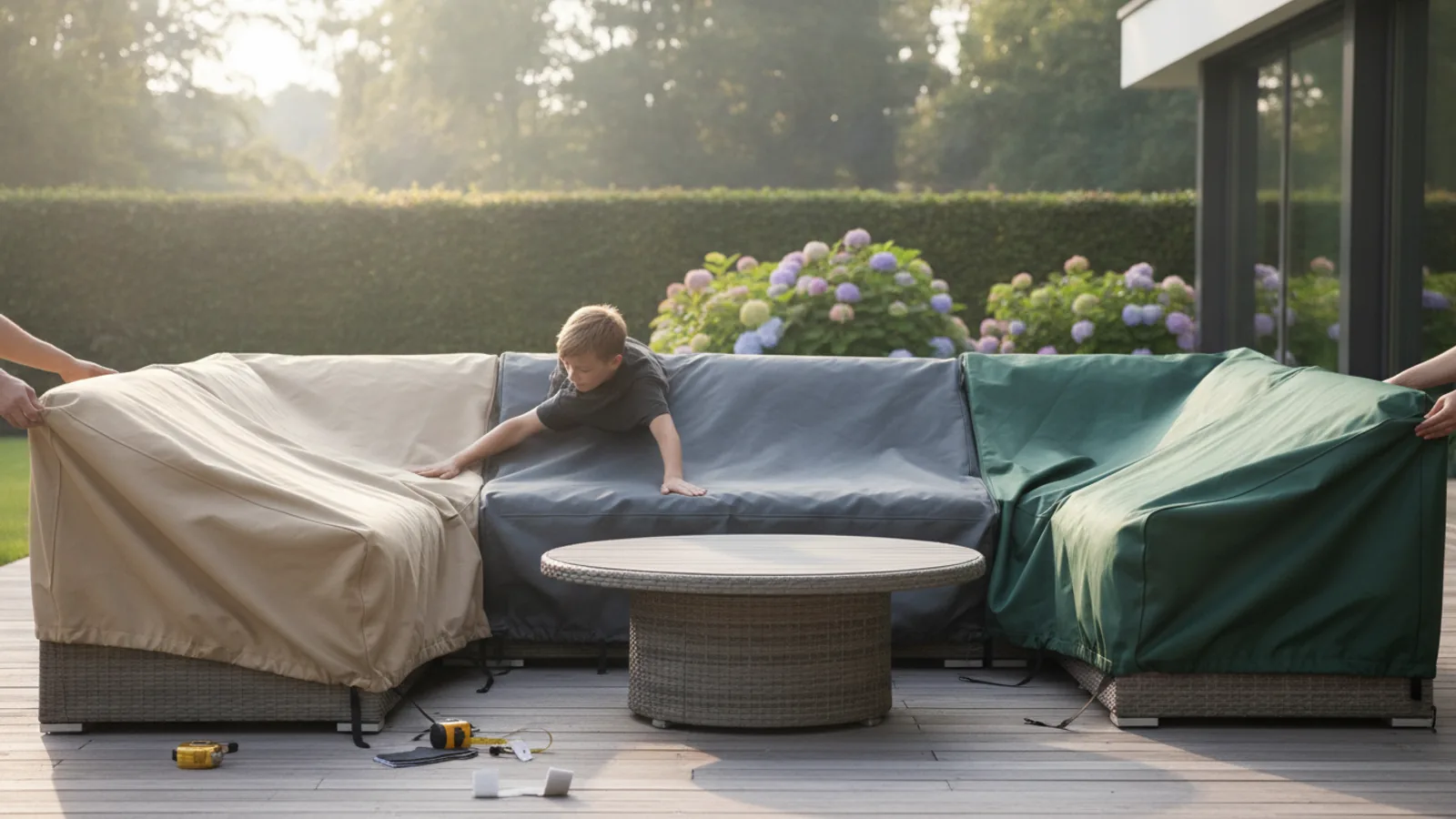
Lay the cover over the furniture or hold it in place if the furniture is too large to move. Find the cover’s corners and line them up with the furniture’s corners. A good fit means each corner pocket or seam sits near the furniture’s corner without pulling hard or leaving a large empty gap. Check the seams that run along the top and sides. If a seam is stretched tight enough to show white stress lines, the cover is too small in that direction. If a seam floats far above the furniture, the cover is too large and may catch wind. Walk around the furniture and check all four corners, because a cover can fit one side well and still be wrong on the other. This step matters because corner and seam alignment shows whether the cover’s shape truly matches your furniture, not just its overall size.
Test the hem, skirt, and ground clearance
Look at where the cover’s bottom hem or skirt ends. A well-fitting cover usually reaches low enough to protect the legs or base but not so low that it pools on the ground. Measure the distance from the furniture’s lowest point to the ground, then compare it to how far the cover hangs. If the hem touches the ground and leaves extra fabric, water can wick up and debris can collect. If the hem stops too high, rain and sun can reach the lower parts of the furniture. Check the skirt around all sides, not just the front, because a sloped ground surface or uneven patio can change clearance. This check matters because ground contact affects drainage, airflow, and how long the cover lasts. Adjust the cover or consider a different size if the hem sits badly on any side.
Evaluate fasteners and wind resistance
Inspect the cover’s fastening system, such as ties, buckles, elastic hems, or weighted corners. With the cover in place, fasten every strap or tie according to the product instructions, then tug lightly on each one to see whether it holds without pulling the cover out of shape. A cover that fits well should stay in place with normal fastening, not require extra rope or clips. Check whether the fasteners line up with your furniture’s legs or frame. If a strap has no matching anchor point, the cover may flap in wind even if the fabric size is correct. Walk around the furniture and push gently on the cover’s side to see how much it moves. This check matters because wind is a common cause of cover damage, and fasteners that do not match your furniture can make a good-sized cover perform poorly.
Do a full test-fit and note adjustments
After checking size, corners, hem, and fasteners, leave the cover on for a short trial period, such as an afternoon, and observe how it behaves. Look for areas that sag, pull, or balloon. Check whether water would drain off the top rather than pool in low spots. If the cover has a vent or mesh panel, confirm it is positioned where air can move. Note any adjustments you had to make, such as tightening a strap, tucking extra fabric, or adding a support under a low spot. These notes help you decide whether the cover truly fits or merely covers the furniture. A cover that needs constant adjustment is probably the wrong shape or size. If you are comparing two covers, repeat this test with each one and compare your notes side by side.
Quick Reference
| Situation | Action | Why it helps |
|---|---|---|
| Your furniture is wider at the arms than at the base. | Measure across the arms at their widest point and compare that number to the cover’s listed width range, not the base width. | A cover sized to the base will pull tight across the arms, which can strain seams and leave the lower furniture exposed. |
| The cover’s hem touches the ground and leaves extra fabric. | Check whether the cover has a shorter skirt option or whether you can raise the furniture slightly with leg pads or a low platform. | Ground contact can wick moisture, trap debris, and reduce airflow, which may shorten the cover’s useful life. |
| The cover fits but flaps in light wind. | Fasten every tie and buckle, then add a compatible strap or weight only if the manufacturer’s instructions allow it. | Flapping causes abrasion and stress at seams, and adding unauthorized weights can damage the cover or furniture. |
Common Issues
- The cover looks right but will not stay centered on the furniture.: Measure the furniture’s diagonals from corner to corner and compare them to the cover’s corner spacing; an uneven diagonal means the furniture is not rectangular, so choose a cover shaped for curved or irregular furniture.
- The cover is too tight at the corners and hard to pull down.: Stop pulling and check whether you are using the correct size for the furniture’s tallest point; if the height range is too short, size up or choose a cover with adjustable corner straps rather than forcing the fabric.
- Water pools on top of the cover after rain.: Check whether the cover has a vent or a peaked design, and confirm that the top is not sagging between support points; if it sags, add a compatible center support under the cover or choose a cover with a tensioned top.
Advanced Tips
- Measure furniture after it has been outside for a while, because heat and moisture can slightly change wood or cushion dimensions.
- Use a flexible tape measure for curved backs and arms, and write down both the straight-line and curved measurements for comparison.
- Compare the cover’s stated fabric weight and breathability to your climate; a heavier cover may fit well but trap moisture in humid conditions.
Final Checklist
- Confirm your widest width, deepest depth, and tallest height are all within the cover’s listed ranges.
- Verify that all corners and seams align without pulling, sagging, or leaving large gaps.
- Check that the hem clears the ground or drains properly on every side of the furniture.
- Fasten every tie and buckle and confirm the cover stays in place with light wind and normal handling.
FAQ
How do I measure furniture with a curved back?
Measure the straight-line distance from the front edge to the back edge, then measure along the curve from the same two points. Compare both numbers to the cover’s depth range, and choose a cover that lists a curved or shaped fit if the curve is large. If the cover is described only as rectangular, the curve may cause tight spots or gaps even when the straight-line measurement matches.
Should I size up if my furniture is between two cover sizes?
Sizing up is often safer when your furniture’s widest or tallest point is near the top of a range, because extra slack can be managed with fasteners and ventilation. However, too much slack can cause flapping and water pooling. Check the cover’s fit notes and return policy, test the larger size first, and only keep it if the hem, corners, and fasteners still behave well.
What if the cover fits but the fasteners do not line up?
Do not force the fasteners or tie them to unrelated parts of the furniture. Check whether the cover has adjustable straps or alternate anchor points, and read the manufacturer’s instructions for approved ways to secure it. If no fastener matches your furniture, the cover’s shape may be wrong for your piece. A cover that cannot be secured properly may flap, wear out faster, or fail to protect the furniture in wind and rain.