How To Measure Outdoor Cushions For Replacement Covers
A practical step-by-step guide to how to measure outdoor cushions for replacement covers, including preparation, instructions, common issues, tips, and next steps.
How To Measure Outdoor Cushions For Replacement Covers
Measuring outdoor cushions for replacement covers is a careful task that ensures a snug, professional fit without guesswork. This guide walks you through preparing your cushions, taking accurate length, width, and depth measurements, accounting for seam allowances and fabric behavior, and verifying your numbers before ordering or sewing. You will learn to handle rounded corners, tapered shapes, and thickness differences that often cause covers to fit poorly. By following the six steps and using the checklists, you can create covers that stay put, resist weather, and look neat on your patio furniture. The process works for box cushions, tufted styles, and simple seat pads, whether you plan to sew or have covers made.
Fast Answer
- For a rectangular cushion, measure length and width at the widest points, then measure thickness at the center and corners; add seam allowance only after recording true dimensions.
- For rounded or tapered cushions, trace the shape onto paper or use flexible tape to capture curves, then measure the straight sections and note the radius of each corner.
Before You Start
- Gather a flexible measuring tape, a retractable metal tape, a ruler or straightedge, a pencil, paper, and a helper to hold the cushion steady while you measure.
- Remove any old covers if possible so you measure the bare cushion, and note whether the filling is firm, compressed, or lumpy because this affects thickness readings.
- Clean the cushion surface and let it dry completely, since dirt or moisture can change how the fabric lies and lead to inaccurate numbers.
- Take measurements in good light on a flat, stable surface such as a table or floor, and record each number immediately with a label for length, width, and depth.
Step-by-Step Instructions
Prepare the cushion and workspace
Place the bare cushion on a flat, stable surface in good light. If the cushion has a removable cover, take it off so you measure the filling directly. Fluff or reshape the filling by hand, pressing out lumps and restoring the corners, because compressed foam can read smaller than it will be in use. Use a flexible measuring tape for curves and a metal tape for straight runs. Ask a helper to hold the cushion steady so it does not slide while you work. Write down each measurement right away with a clear label, and note the date and cushion location, such as 'left chair seat' or 'bench back'. This order matters because a clean, still cushion gives repeatable numbers, and repeatable numbers are the only reliable basis for a cover that fits without pulling or sagging.
Measure length and width at the widest points
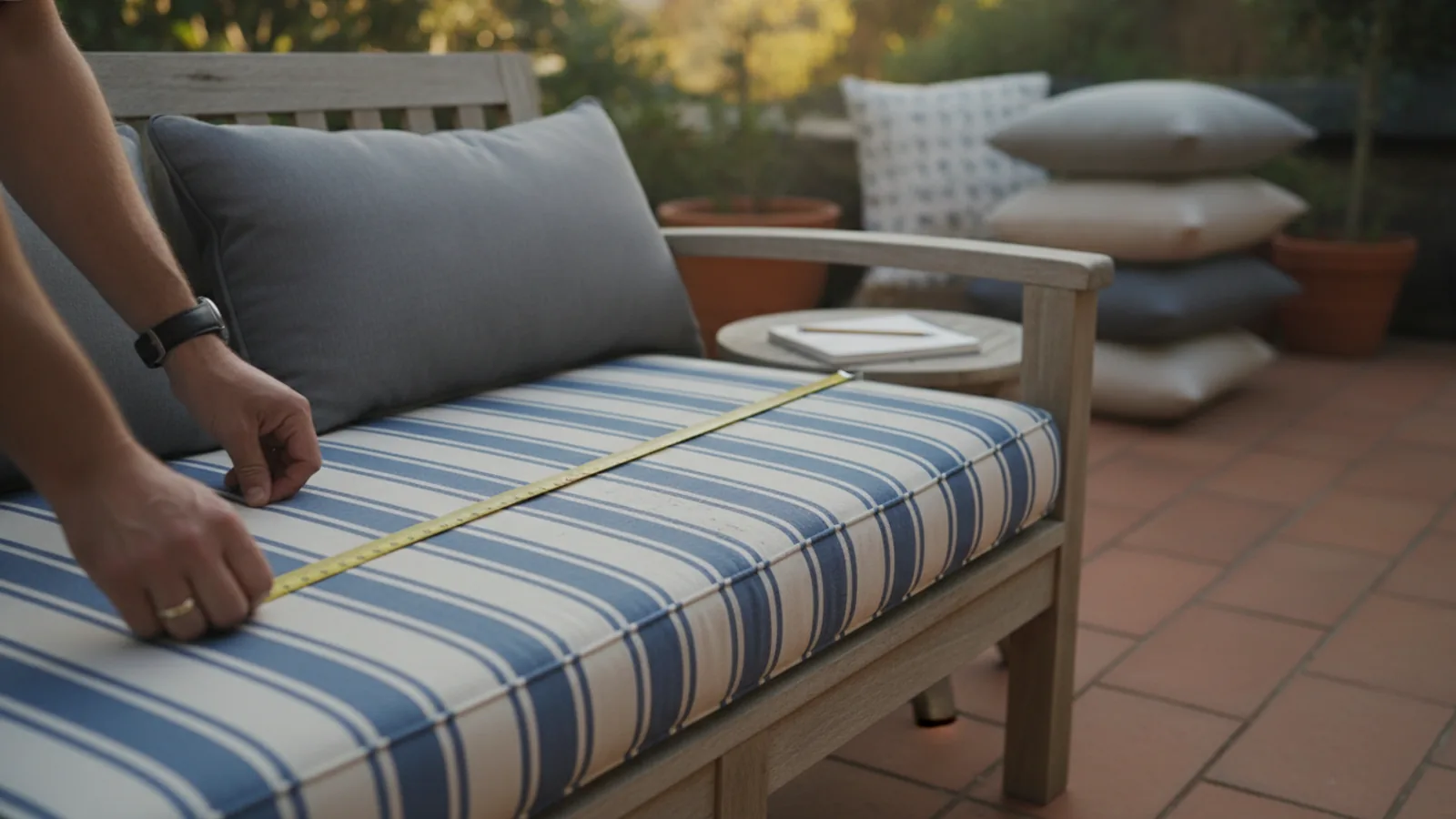
For a rectangular or square cushion, measure the length from the front edge to the back edge, keeping the tape parallel to the sides. Then measure the width from side to side at the widest point, which is often across the middle. If the cushion is tapered or rounded, measure the widest and narrowest points and record both, because a cover cut to only one number will bind or wrinkle. Pull the tape snug but not tight, and let it follow the surface rather than bridging over a dip. Mark the endpoints lightly with a pencil or place a small piece of removable tape as a reference. Check each measurement twice, and if the two readings differ, take a third and use the average. This check matters because length and width are the foundation of the pattern, and a small error here multiplies when you add seam allowance.
Measure thickness at corners and center
Thickness, also called depth or height, is the measurement most often guessed wrong. Place the tape vertically at one corner and measure from the top surface to the bottom surface, keeping the tape straight and not angled. Repeat at the opposite corner and at the center of the cushion. If the three numbers differ by more than a small amount, write down the largest and smallest, and note where each occurs. A cushion that is thicker in the middle needs a cover with a generous depth allowance, while one that tapers may need a shaped side panel. For box cushions with a gusset, also measure the width of the side panel if it is visible. Verify by stacking two rulers or a ruler and a book against the cushion side and reading the gap. This check matters because thickness controls how the cover wraps the edge and whether the zipper or closure will close without strain.
Trace curved and irregular shapes
Many outdoor cushions are not simple rectangles; they may have rounded corners, a curved front, or a tapered back. To capture these shapes, lay a large sheet of paper or pattern paper on a flat surface and place the cushion on top. Trace around the cushion with a pencil, holding the pencil vertically and keeping it in contact with the cushion edge. For thick cushions, trace the top and bottom separately if the shapes differ, and mark which is which. If the cushion is too large for one sheet, tape sheets together on the back before tracing. Then measure the straight sections and the radius of each rounded corner. To find a corner radius, place a ruler against the straight edges and measure the distance from the corner point to where the curve begins. This order matters because curves cannot be captured by length and width alone, and tracing gives you a true template instead of an approximation.
Add seam allowance and ease
Once you have the true cushion measurements, decide how the cover will be constructed. If you are sewing, add a seam allowance to every edge that will be sewn, and add a little ease so the cover slides on without fighting the filling. A common approach is to add the same seam allowance all around, then test with a scrap of fabric before cutting the final material. If you are ordering a custom cover, ask the maker whether their process already includes seam allowance and ease, and give them the bare cushion measurements plus any notes about thickness variation. For firm foam, you may need less ease; for soft filling, you may need more. Write the final cut dimensions in a separate list and double-check them against the bare measurements. This check matters because mixing up bare measurements with cut dimensions is a leading cause of covers that are too tight or too loose.
Verify measurements and plan the closure
Before you cut or order, re-measure the cushion one more time using your recorded numbers as a guide. If any reading differs from your first pass, take a third measurement and resolve the difference. Then plan where the closure will go, such as a zipper along the back edge or a flap with ties, because the closure affects how much fabric you need and how the cover fits. Measure the length of the opening you want and confirm it is long enough to insert the cushion without stretching the fabric. Also check that the cover will clear any frame, armrest, or tie-down points on your furniture. Lay the cushion in its intended spot and look for gaps or overlaps. This final check matters because a cover that measures correctly but cannot be installed or that catches on the frame will still fail in daily use.
Quick Reference
| Situation | Action | Why it helps |
|---|---|---|
| You are measuring a rectangular seat cushion with firm foam. | Measure length and width at the widest points, then measure thickness at all four corners and the center, and record the largest thickness. | Firm foam resists compression, so the largest thickness prevents a cover that is too tight and stresses the seams. |
| You are measuring a rounded or curved back cushion. | Trace the outline on paper, mark the top and bottom, and measure the straight sections plus the radius of each curved corner. | Curves cannot be captured by length and width alone, and a traced template prevents flat spots or puckers in the finished cover. |
| You are ordering a custom cover from a maker. | Ask whether their process includes seam allowance and ease, and provide bare cushion measurements with notes on thickness variation and shape. | Makers use different construction methods, so confirming their expectations prevents a cover that is too small or too baggy. |
Common Issues
- The old cover measures differently from the bare cushion.: Always measure the bare cushion, not the old cover, because fabric stretches with use and seams add bulk. If you must use the old cover as a reference, measure it flat and then subtract the seam allowance and any stretch you can see, but treat the bare cushion as the source of truth.
- The cushion is thicker in the middle than at the corners.: Record both the largest and smallest thickness, and note where each occurs. When making or ordering, use the largest thickness for the side panel and add a note about the taper so the cover can be shaped or the filling can be adjusted before the cover is closed.
- Rounded corners are hard to measure accurately.: Trace the corner onto paper, then measure the radius by placing a ruler against the straight edges and finding the distance from the corner point to where the curve begins. Repeat for each corner, and if the radii differ, use the largest one and mark its location on your template.
Advanced Tips
- Measure cushions in the morning before they warm up and soften in the sun, because heat can change how foam and fiberfill behave and give you a smaller reading.
- For piped or welted cushions, measure to the outside of the welt and add a note, so the cover can either cover the welt or sit just inside it depending on your design.
- Keep a dedicated measurement notebook with a sketch of each cushion, the date, and the furniture piece, so you can reorder or repair covers later without starting over.
- If you plan to use outdoor fabric that may shrink, wash and dry a test swatch first, then measure the swatch again to calculate the true shrinkage before you cut.
Final Checklist
- Confirm you measured the bare cushion, not an old cover, and that the filling is fluffed and in its normal shape.
- Verify length, width, and thickness at multiple points, and record the largest and smallest values with their locations.
- Check that curved or tapered shapes have been traced and that corner radii are noted on your template.
- Review your cut-size list against the cushion-size list, and confirm closure placement, seam allowance, and ease before cutting or ordering.
FAQ
Should I measure the cushion or the old cover?
Measure the bare cushion. Old covers stretch, shrink, and include seam bulk, so they rarely match the true cushion size. If you only have the old cover, measure it flat, then subtract the seam allowance and account for any visible stretch, but use the cushion itself whenever possible.
How do I measure a cushion with rounded corners?
Trace the cushion outline on paper, then measure the straight sections and the radius of each corner. To find a corner radius, place a ruler against the straight edges and measure from the corner point to where the curve begins. Record each radius separately if they differ, and use the largest one for your template.
What if my cushion is thicker in some places than others?
Record the largest and smallest thickness and note where each occurs. Use the largest thickness for the side panel so the cover does not strain, and tell your maker or adjust your pattern for the taper. If the difference is large, consider reshaping or replacing the filling before making the cover.